
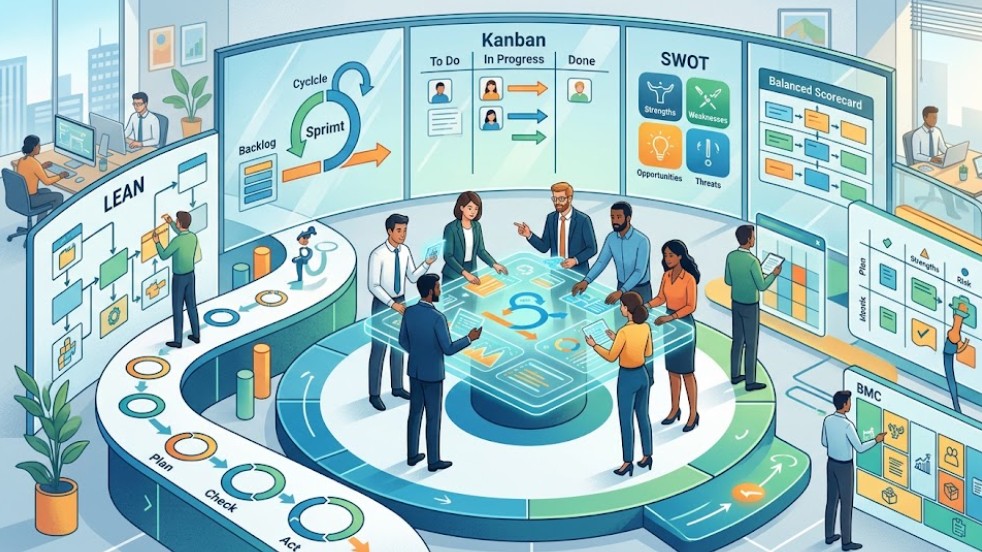
In the modern corporate landscape, execution is everything. Yet, many organizations fail not because they lack ambition, but because they lack a unified structure to channel that ambition. Business frameworks and methodologies are not mere corporate buzzwords; they are the intellectual scaffolding that converts chaotic market signals into structured strategy and predictable execution.
However, a tool is only as good as the problem it is deployed to solve. Misapplying a framework is often worse than having none at all. To drive meaningful growth, leaders must understand when to use a static strategic model versus a dynamic operational methodology.
1. Strategic Frameworks: Mapping the Vision
Strategic frameworks are diagnostic. They help executives zoom out, analyze market variables, and decide where to play.
The Balanced Scorecard (BSC)
Coined by Robert Kaplan and David Norton, the Balanced Scorecard prevents organizations from falling into the trap of short-term financial myopia. It forces a holistic view of the enterprise across four equal perspectives:
- Financial: How do we look to shareholders?
- Customer: How do customers see us?
- Internal Business Processes: What must we excel at?
- Learning & Growth: How can we continue to improve and create value?
When to use it: During annual strategy refreshes to ensure operational KPIs (Key Performance Indicators) align with long-term corporate health, rather than just immediate revenue goals.
Blue Ocean Strategy
Developed by W. Chan Kim and Renée Mauborgne, this framework challenges the traditional obsession with beating the competition. Instead of fighting over a crowded market (“Red Oceans”), companies are encouraged to create uncontested market space (“Blue Oceans”), rendering the competition irrelevant.
| Red Ocean Strategy | Blue Ocean Strategy |
| Compete in existing market space. | Create uncontested market space. |
| Beat the competition. | Make the competition irrelevant. |
| Exploit existing demand. | Create and capture new demand. |
| Make the value-cost trade-off. | Break the value-cost trade-off. |
2. Operational Methodologies: Executing the Plan
While strategic frameworks define the destination, operational methodologies are the engines that get you there. They are dynamic, iterative, and heavily focused on execution.
Objectives and Key Results (OKRs)
Popularized by Intel and Google, OKRs are the gold standard for modern goal-setting. They bridge the gap between high-level strategy and daily execution.
- Objectives: Qualitative, ambitious, and time-bound goals (The Where do we want to go?).
- Key Results: Quantitative, measurable milestones that prove you achieved the objective (The How do we know we got there?).
The Golden Rule of OKRs: Key Results must be outcomes, not activities. “Launch a new marketing campaign” is a task. “Increase inbound lead velocity by 25%” is a Key Result.
Agile & Scrum
Originating in software development but now widely applied to marketing, HR, and product management, Agile prioritizes adaptability over rigid planning.
Through the Scrum framework, teams work in short, fixed-length cycles called sprints (typically 2–4 weeks). This allows organizations to ship value to customers faster and pivot instantly based on real-world feedback rather than relying on outdated annual predictions.
3. Continuous Improvement: Optimizing the Core
For mature organizations, the priority shifts from discovering new markets to maximizing the efficiency of existing operations.
Lean Six Sigma
This hybrid methodology combines Lean (focused on eliminating waste and non-value-added steps) with Six Sigma (focused on reducing process variation and defects using rigorous statistical analysis).
It relies heavily on the DMAIC framework:
- Define the problem.
- Measure key aspects of the current process.
- Analyze the data to find the root cause of defects.
- Improve the process by eliminating the root cause.
- Control the future state process to prevent deviations.
Conclusion: Avoiding the “Framework Trap”
The ultimate pitfall for any leader is treating a framework like a silver bullet. Frameworks do not make decisions; leaders do.
The most successful companies do not adopt a single methodology dogmatically. Instead, they build a customized toolkit—using a Blue Ocean mindset to find their market, OKRs to align their teams, and Agile to execute the daily work. The goal is never to “do Scrum” or “be Lean”; the goal is to build a resilient, high-performing organization that wins.
Leave a Reply